Third Spaces and the Price of Play
Once upon a time in a land far, far away, kids had a place to be.
A soda shop. The mall. A roller rink. The park. Places where you shared the name of your crush, or worked up the courage to ask her out. The place your friends took you after a fight with your parents, a surprise bad grade, or just when you needed to get away from it all and unwind.
These were the places you didn’t have to explain yourself. Where you could loiter, linger, just chill. This is where life happened.
Thanks for reading Cara’s Substack! Subscribe for free to receive new posts and support my work.
They’re called third places. They have a name and a purpose. And they’re quietly disappearing – or becoming priced out of reach – at the exact moment the world is becoming more challenging, not less.
A world where income inequality grows by the minute, where groceries with wildly inflated prices are guarded by 300-pound security officers in what look like bulletproof vests.
Where almost everything now feels like pay-to-play.
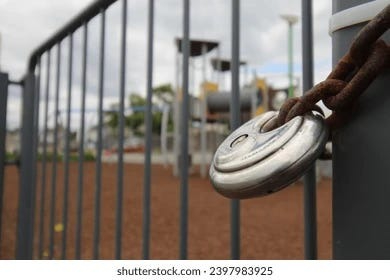
Community services are disappearing. The public pools are closing, and now there are private swim clubs in their place with long waitlists and steep dues.
The rec centers now charge for everything.
After-school programs that used to be free now cost hundreds per season.
Even public fields are now closed to the public much of the time, rented out by private sports clubs for kids (soccer, baseball, all manner of sportsball). Because heaven forbid kids have space for unstructured play, right?
On a recent trip my family took through the national parks in the American Southwest, the message was just as clear. Trails that should be open to all now require reservations, entrance fees, and sometimes guided tours that cost more than a night in a hotel.
Places once meant to be wandered now feel curated and exclusive… like private property.
The most beautiful views often come with a price tag. I’ve seen the same thing in England and other places I’ve visited recently. Public land, protected land, has become a commercial enterprise. It’s marketed to tourists, sold back to us.
This land is our land for Heaven’s sake. Even if we hadn’t already paid for its upkeep, this would be robbery. But we have paid (through taxes, as citizens). And now we’re paying again.
This creeping privatization of everything – of joy, of nature, of community – is brutal.
Even getting on a plane has become transactional at every turn.
You can buy a seat, or let the system assign one and hope you’re not separated from your kid. If you have carry-on luggage, that’s extra.
If you want to check a bag, even more.
Every little comfort that used to be included now comes with a fee. There’s no baseline anymore – just tiers, upgrades, and punishments for people who can’t afford to play along.
None of this is invisible. It wears on people. It teaches kids early that belonging, joy, nature, rest – these things are privileges, not rights.
This is what happens when community is replaced by commerce. It isolates. It excludes.
We should be alarmed by this. Because when spaces for unstructured play, connection, and rest disappear, they don’t simply vanish, they are replaced. Often by screens. By systems that profit from attention, anxiety, and overstimulation.
The loss of third places isn’t just nostalgic. It’s consequential. And we are already living with the results.
Welcome!
I’m a neurodivergent person raising neurodivergent children, doing my best to make the world a little kinder and a little more tuned in.
Most of what I write comes from lived experience tempered by self-discovery and a whole lot of reading and learning. I have a science degree in psychology, but the real substance comes from the extensive, deep research I’ve done to understand the world I actually live in. Not theory from a distance, but the patterns, physiology, and human realities that shape daily life for neurodivergent families.
This is the work I try to do here. I take the moments that feel impossible, the ones that make you question yourself or your child, and I slow them down. I break them open in a way that shows the sense inside them. I write about what happens in the body before the behavior ever shows up. I offer language that protects dignity. I try to make room for connection instead of control.
If your family moves through life with intensity, sensitivity, overwhelm, shutdowns, meltdowns, refusals, brilliance, creativity, and everything in between, you’ll probably recognize yourself here. And if you’re looking for a way to meet those moments without losing yourself, you may find something useful.
My world is small, but I know we’re not alone. If this space becomes a touchpoint for someone who needs clarity or company, then it’s doing its job.
Share:
Facebook
Twitter
Pinterest
LinkedIn